

“But truth is not the worst of it. No. What follows is. The living with it. Enduring the dichotomy. Knowing there is something perfect trapped in your flawed human shell, reminding you of both what you were and what you will never fully be.”
— Jonathan Hickman, Powers of X #3 (21 August 2019)
I first found out that I was afflicted with intense intrusive thoughts in my late thirties. I’ve experienced them throughout my entire life, and they grew stronger and louder as I grew older. I did not know what they were — or that they had a name — until I was already an adult, though I was just as terrified of them as any child might be.
Wikipedia’s definition of “intrusive thoughts” cuts right to the heart of the concept:
An intrusive thought is an unwelcome, involuntary thought, image, or unpleasant idea that may become an obsession, is upsetting or distressing, and can feel difficult to manage or eliminate. When such thoughts are associated with obsessive-compulsive disorder (OCD), Tourette syndrome (TS), depression, body dysmorphic disorder (BDD), and sometimes attention-deficit hyperactivity disorder (ADHD), the thoughts may become paralyzing, anxiety-provoking, or persistent. Intrusive thoughts may also be associated with episodic memory, unwanted worries or memories from OCD, post-traumatic stress disorder, other anxiety disorders, eating disorders, or psychosis. Intrusive thoughts, urges, and images are of inappropriate things at inappropriate times, and generally have aggressive, sexual, or blasphemous themes.
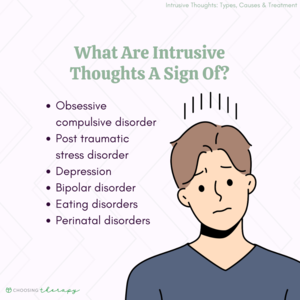
Obsessive-compulsive disorder? Depression? Anxiety disorders? At some point, I’ve been diagnosed with all of those horrible things. It’s like I won one of the lesser prizes in “mental illness bingo,” only that’s not something anyone would want to win and I never actually wanted to play the game.
I could tell you about treatment, of course. I’ve had whatever therapy I could afford,1 and I’ve been prescribed various antidepressants over the years. I could link websites and case studies aplenty, and you can find many of those pages yourself with a simple Internet search.
I won’t go into any of the science here, as I am neither a trained scientist nor a licensed therapist. Instead, I want to talk about the experience of suffering with the often mind-numbing combination of OCD / OCPD and intrusive thoughts.
 For me, these intrusive thoughts began in my teenage years. Initially, these thoughts were just angry — screaming back at those who hurt me physically or emotionally, even if that hurt was only perceived and not actual. At times, I would act on these thoughts without realizing what I was doing at the time, then I would try to rationalize what I did later instead of properly analyzing my actions and making amends to those I’d wronged or offended.
As I grew older, however, a myriad of bigoted thoughts I had never experienced before added themselves to the mix, though the thoughts were not noticeable enough to be problematic at the time. These troublesome thoughts were vexing, but they were still relatively easy to deal with. I quickly learned to differentiate them from my normal thought processes enough that I stopped acting on them and began ignoring them instead. I briefly stopped experiencing them for a couple of years; the depression and loneliness I was feeling at the time were far stronger and impossible to ignore.
In my late teens, I joined an extreme modalistic fundamentalist evangelical Christian sect. In three years’ time, the intrusive thoughts evolved in response: the rage component waned and faded into the background, but a new blasphemous component inserted itself into my mind. These thoughts… these thoughts were noticeable indeed, and they frightened me.
There’s no way to ignore thoughts instructing you to curse the Deity you are actively praying to at the moment. It felt like being locked in a room with an rage-fueled, vitriolic blowhard on the radio2 demanding I do or say what he tells me to do or say (which is the exact opposite of what I want to do or say) while I’m trying to go about my business as usual, but I cannot turn off or unplug the radio, nor can I change the frequency to a different station. It felt like being a Zen-practicing, left-leaning pacifist hippie being forced to listen to Alex Jones’s angriest, craziest, most offensive videos at gunpoint, but no matter how hard you try you just can’t convince the gunman to put you out of your misery and shoot you.
I am mild-mannered Dr. Henry Jekyll and the paranoid, vitriolic voice of Edward Hyde inside my head never stops screaming at me.
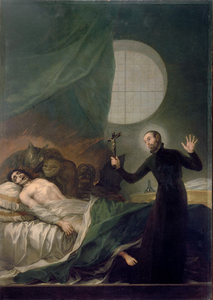 At first, I honestly thought demons were trying to possess me. Given my religious beliefs and what I was experiencing at the time, would that be such a difficult concept to believe? I was hearing really loud thoughts that didn’t feel like my thoughts, and they were telling me to hate my own God or projecting non-stop anger, paranoia, and anxiety toward everyone around me… in some cases, people I knew and loved deeply.
Wouldn’t you think you were hearing demons?
Years passed and the thoughts only grew stronger and louder, to the point where they can be deafening at times. I’ll be working, reading, writing, trying to watch a movie, eating, praying, or doing any number of other things, and out of nowhere, an inner voice is SCREAMING AT ME so loud that I can’t ignore what it’s saying, so thunderous that they sometimes overpower my normal thought processes.
Counselors and psychologists instruct their patients to train themselves to acknowledge these thoughts, then to release them. I try to do this, but I’ve never been any good at doing that. Many times, these thoughts have stopped me in my tracks; I can’t do anything but try to fight them or to ignore them, then power through them and get back to my day as best I can.
I have these thoughts several times during any given hour, sometimes several hours during any given day. They can occasionally be non-stop, only relenting when I fall asleep, a mild headache tugging at the sides of my head.
I can’t really tell what triggers these thoughts, as I really don’t know for certain. Sometimes, just looking at another person, be it someone I know or some random stranger, triggers the thoughts. The blasphemous thoughts were sometimes triggered by prayer, by reading scripture, or by even thinking about God or theology in general. Now, they can be triggered just by simple words like love or hate, whether they are directly or tangentially related to religion/theology or not.
To the converse, I could be conversing with a friend or relative about something as innocuous as ice cream flavors and mentally discombobulating thoughts immediately trigger. A particularly shocking intrusive thought pops into my head that prompts me to clamp my mouth shut, close my eyes tight, and either fight the thought with contrary thoughts or just try to power through the thought and let it pass without bothering me.3
These are the tamer thoughts and the milder triggers I’ve experienced. I’ve had much, much worse over the years. My mind is a charnel house, and the blood never seems to stop flowing, no matter how often the lambs bleat for the slaughter to cease.
 While the thoughts themselves are mind-numbing, the shame associated with such thoughts is equally as addling. Sometimes, I am moved to pray after fighting the thoughts or to remain silent when in conversation with others, even when I have something pertinent to add to the conversation. I even avert my eyes when speaking with friends and loved ones out of paranoia that someone might see the battle going on inside me if they look into my eyes too deeply.
Sometimes, I feel like Nightcrawler — the lovable, upbeat, devout Catholic mutant Kurt Wagner of the Munich Circus — from the second X-Men film: in the film, Nightcrawler etches an Enochian symbol into his skin in penance for every sin he commits, even though the sins he commits at the beginning of the film were committed under someone else’s directions via chemical-induced brainwashing.
That’s how the thoughts make me feel: like someone else is committing the sin, but I bear the guilt and the need to pay for it… and anyone who merely glances at me can easily see the sins permanently marking me.
 At other times, though, I feel like another X-Man, Legion — Professor Charles Xavier’s illegitimate son, David Haller, ostensibly afflicted with dissociative identity disorder (DID), or what we used to call “multiple personality disorder”.4 It feels like other people are whispering their twisted, horrifying thoughts into my head against my will whenever they please, and I am, unfortunately, along for the ride whether I like it or not.
Sometimes, the thoughts are louder and more frequent. At other times, I could go almost an entire day without them bothering me, and when they do they’re relatively easy to manage. I have no idea why this variation in experience exists. There may be some nefarious biological component at work: I’m a Type 2 diabetic, so having more sugar in my bloodstream at any given moment may cause the thoughts to be stronger, louder, and more frequent than at other times. I am still looking into this possibility at present.
When used often and used well, the medications I have been prescribed by past therapists have had positive effects on the intrusive thoughts. The thoughts are still present, but they aren’t as intense or as frequent, and when they do voice themselves they are much easier to manage. Unfortunately, a few of my medications can cause extreme drowsiness, so I take doses late at night rather than take them throughout the day, as I would be too drowsy to work. This may have affected the drug’s effectiveness somewhat, for all I know.
Then again, dealing with the thoughts throughout the day — especially when I’m trying to work — can also be mentally exhausting as well. I don’t work a physically taxing job, but I often feel like falling asleep right after work due to extreme mental exhaustion.
I will still fight through the thoughts, though, and one day I will win this fight. I lived without the thoughts before, and I will do so again someday soon.
I hope this has given you an insight into intense and frequent intrusive thoughts and into the minds of those who suffer with them. Throughout this post — from the post’s featured image (see below) and the Jonathan Hickman quote prefacing this missive to the Nightcrawler reference discussed later — you may have noticed references to Marvel’s wildly popular X-Men franchise. These references are, of course, intentional: suffering from mental health issues makes me feel like a mutant at times… but not in any positive aspects.
If you know someone afflicted by such thought processes, please have empathy and understanding for them. If they seem exhausted at times or if they have no energy for projects they may have been excited over days or hours before, maybe now you know where their energy went (especially if they also suffer from Bipolar disorder). If they aren’t getting the mental health care they need, try to aid them in getting that much-needed help.
Above all else, please be kind to one another. We need each other.

- I haven’t been able to afford much therapy, mind you, and never the best therapies. The American mental health care system is abysmal. Mental health care has evolved in leaps and bounds since the days of Freud and Jung, but we’re still learning so much about the human mind… and ensuring affordability for proper treatment — or that health insurance companies take mental health seriously enough to cover treatment at all — is still an uphill battle for the American medical system.[↩]
- For you younger folks, imagine I’d said YouTube instead of radio and everything should make sense.[↩]
- If you ever meet me in person, you’ll know when this happens when you see it, if you’re observant enough. It’ll look like I’m either lost in a difficult moment of prayer or trying to pass extremely painful gas.[↩]
- In the comics, Legion’s DID was initially caused by all the deceased people who died when the bus young Legion was traveling aboard was destroyed by a terrorist bomb, and Legion — an immensely gifted telepath like his father, unbeknownst to David himself — inadvertently absorbed the thoughts and personalities of the terror attack victims into his own mind[↩]
