


Last time, I promised to list my favorite Star Trek films.1 Presented in this article by no one’s suggestion are my personal “Top Seven” favorite Star Trek motion pictures to date.2
Author’s Note: No, I am NOT considering the parody film Galaxy Quest a true Star Trek film for the sake of this list article.3 Who do I look like, Michael Okuda?

7. Star Trek V: The Final Frontier (1989)
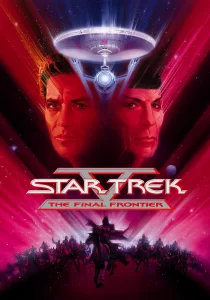 This film was hailed as the worst Star Trek film ever made… until the horrible Star Trek Into Darkness was released in 2013. Then the impressively awful Star Trek: Section 31 came out later in 2025. Now, Star Trek V just seems kind of cute, quirky, and quaint when set against those two dreadful films, like comparing a bad fireworks mishap to Hiroshima and Nagasaki.4
To be honest, I’m quite pleased with that outcome. While it has never been in my top three favorite Star Trek films, I’ve always enjoyed Star Trek V, silly as it is.
Just look at that movie poster! Such clean lines, all repeating the V shape of the Roman numeral Five! It promises so much, doesn’t it? Kirk and Spock versus an interstellar Genghis Khan-type force? Hell, sign my fat ass up! I don’t know how that would work logistically, but it sounds like a cool idea!
The actual movie is so much different…
So, William Shatner and Leonard Nimoy had something of a friendly rivalry ever since Star Trek: The Original Series was on the small screen. They used to argue over who had the most lines of dialogue in a given script or who got the best lines. That petty phaser-waving contest persisted to some degree into their older, post-middle age lives as well.5 Nimoy got to direct both Star Trek III: The Search for Spock and Star Trek IV: The Voyage Home, and Shatner wanted a piece of that action.
The studio let Shatner write and direct Star Trek V: The Final Frontier, and he wanted to make it a big, dark, brooding, gritty commentary on life filled with sex, violence, political intrigue, and ending in a tussle with Captain Kirk versus God Himself,6 like an Eric Van Lustbader fantasy thriller7 combined with a Trekkie’s version of the Bible. The main villain, the Vulcan cult leader Sybok, was even inspired by some televangelist Shatner had seen on a late night evangelical program.
I have to admit, all that sounds like a pretty bitchin’ concept for a film like Total Recall… but not for a Star Trek film! The studio apparently agreed with me, because the Paramount executives — still swimming in the boat loads of cash they made from Star Trek IV and in no mood to get out of the pool just yet — wanted Star Trek V to be another fun, light-hearted, comedic romp through space like its predecessor, Star Trek IV.
Shater was faced with a choice: stay true to his artistic vision for the film, or give in to the studio’s demands and make a much different film than he had initially planned to do.
Just like his character Captain Kirk, Shatner chose a third option: “I’ll go with both ideas!”
He chose poorly.
The story is laughably Kirk-centric to the detriment of some of the other characters, who act eerily out of the norm for their well-established personalities. Plot holes roam freely through the script like lost puppies searching for a home, transforming into vast plot singularities that often threaten to swallow the narrative whole. A sixty-plus aged Uhura does a nearly-naked fan dance. This movie is all over the place, and it is as bonkers as terrible Classic Series episodes “Spock’s Brain” or “The Way to Eden” at times.
Yet, just as William Shatner is the living embodiment of the “loveable jerk” trope, so is Star Trek V. The film is awful, but it is charmingly awful! Each character in the Star Trek cast gets their own moment, even though it may be a silly, off-putting, or wildly out-of-character moment. Watch Sulu and Chekov try unsuccessfully to blow off work and stay on their vacation in the woods like a cute little elderly gay couple! Witness Uhura flirt with Scotty out of nowhere (also unsuccessfully), just like watching your grandma making sweet-sexy talk with your grandpa in the kitchen!8 Behold as Kirk proves how ruggedly manly he still is at age 58 by climbing El Capitan only to have to be rescued at the last minute by Spock (who got him into that mess in the first place) while a very worried McCoy watches and has the worst panic attack of his life! Scratch your head in confusion as Scotty does the stupidest, most out-of-character faceplant in the history of Hollywood faceplants! It’s wacky, this Enterprise crew!
Yet, this screwball movie about an emotional Vulcan evangelist/cult leader stealing the Enterprise to search for God features some pretty deep moments that seem almost jarringly good amidst all the Shatneresque silliness. The heavy — renegade Vulcan philosopher Sybok, portrayed masterfully by Tony Award-winner Laurence Luckinbill — has some beautifully poignant moments, and McCoy has a magnificently portrayed, tear-jerking scene between himself and his ailing father (portrayed by DeForest Kelly’s actual father). Even the ending holds much greater meaning than one might have expected from this film. Come for the B-Movie silliness, stay for the surprising moments of depth.
6. Star Trek: The Motion Picture (1979)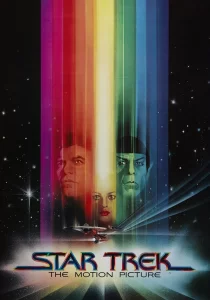
Many Star Trek fans refer to Star Trek: The Motion Picture as “Star Trek: The Motionless Picture” due to its at times glacial pacing. These same fans will defend the merits of the classic science fiction film 2001: A Space Odyssey, even though that film’s pacing is far slower9 and more deliberate.
Quite ironic for a film meant to mimic Star Wars!
The extremely troubled production history of Star Trek: The Motion Picture officially began in 1977, but the idea for a Star Trek film dates all the way back to off-the-cuff discussions between Star Trek creator Gene Roddenberry and actor DeForest Kelly (who portrayed Dr. Leonard “Bones” McCoy). During the pre-production of what was originally entitled Star Trek: The God Thing, Star Trek: The Motion Picture bounced between being a movie and a television episode for a potential Star Trek sequel series a few times until George Lucas‘ first Star Wars film hit theaters and blew everyone’s minds, in and out of Hollywood.
One of those minds was then-president of Paramount Pictures, Michael Eisner, who would later go on to helm the Walt Disney empire. At the time, Eisner — a rising star among the Hollywood executive jet-set with a keen eye for money-making masterpieces — oversaw the productions of beloved movies like Raiders of the Lost Ark and Saturday Night Fever. He saw Star Wars, got dollar signs in his eyes, then immediately ordered The God Thing (which had become the pilot episode for Star Trek: Phase II by then) to be rewritten as a motion picture meant to challenge Lucas’ dominion over the cinema industry.
And man, you can tell this poor script was originally a television screenplay stretched out into a feature length presentation like an unfortunate prisoner whose limbs were pulled apart on a medieval torture rack! Somewhere along the way, someone in the production staff stopped using Star Wars as inspiration and turned to 2001: A Space Odyssey instead.
Is the story perfect? Nope! Not even close! There are plot contrivances aplenty in this movie and plenty of filler scenes meant to “duct tape” scenes written for the pilot episode of Star Trek: Phase II to the scenes written or expanded upon for the motion picture. The villain V-Ger‘s motivations are infinitely intriguing in a philosophical sense,10 but make little sense after you stop to consider the villain’s origins.
And yes, as you’ve no doubt heard, that initial scene introducing the refit Starship Enterprise does indeed go on forever. If you’re into Star Trek “starship porn,” that scene is the money shot of money shots. It even gets recycled (but truncated) in Star Trek II: The Wrath of Khan!
Even so, Star Trek: The Motion Picture — which features such heady, potent themes as purpose, loneliness, evolution, and religion — is a fascinating and highly intellectual, if ponderous, romp through an idyllic future Earth whose production values, acting, and writing elevate an otherwise pedestrian 2001 clone pushed into theaters as a Star Trek-themed cash grab. Thanks to the film’s status as the first Star Trek motion picture presentation, Star Trek: The Motion Picture is still among the highest-grossing Star Trek films ever made.
5. Star Trek III: The Search for Spock (1984)

The very first Star Trek movie I saw was Star Trek III: The Search for Spock on a shiny new VHS (Video Home System) tape owned by my mother’s best friend (her pastor’s wife) in Shreveport back in 1986. I was only four years old, and everything about the movie — the story, the characters, the visuals, the fight between the wounded Enterprise and the stealthy Klingon Bird-of-Prey, those glorious “monster maroon” uniforms — blew my tiny little baby Trekkie mind clear into another galaxy.
In hindsight, Star Trek III doesn’t really measure up to either its preceding or proceeding films. Dark and moody Star Trek II: The Wrath of Khan was a major hit with Star Trek fans, and family-friendly Star Trek IV: The Voyage Home (also known as “The One About the Whales”) was a major hit with mainstream audiences, leaving Star Trek III as the odd man out. At times, the movie feels a little disjointed as it struggles to balance religious themes of death and resurrection with the dark political undertones of its violent villain, Klingon warrior prototype Commander Kruge (portrayed to perfection by Hollywood veteran Christopher “Doc Brown” Lloyd) with the fun, adventurous tone of the Enterprise hijacking.
Nevertheless, I think newbie director Leonard Nimoy does a pretty deft job at keeping the equilibrium between these disparate tones at an even keel throughout the film, diving headlong into the darkness of death twice near the end of the movie before rising to a brilliant crescendo with Spock’s return at the movie’s climax. This film often gets unfairly lumped into the “bad” classic Star Trek movies along with Star Trek: The Motion Picture (often called the “Motionless Picture” due to its glacial pacing), Star Trek V: The Final Frontier (a broken yet hilarious mess of a film written, directed, and starring William Shatner), and Star Trek Insurrection (which might’ve worked as a neat two-part episode of The Next Generation instead of as a standalone spin-off film), but I think Star Trek III is actually the first movie in the classic Star Trek film series to break the “Odd Numbered Star Trek Movies Suck” rule (before Star Trek V reaffirmed it). While I can’t recommend seeing the movie on its own, it certainly works when viewed as a duology with Star Trek II, as this film heavily depends on its predecessor for its plot.
4. Star Trek IV: The Voyage Home (1986)

This fun, light-hearted movie was the first Star Trek cinematic outing to really grip the hearts and imaginations of mainstream audiences the way the television series it’s based on glommed onto the hearts of 1960s science fiction nerds, and it’s not difficult to see why. The film had a very timely yet timeless environmental message, and seeing our normally brilliant, tech-savvy crew as a school of fish out of water when navigating the streets of San Francisco during the upbeat, silly late 1980s was a treat well worth the cost of admission.
Nimoy returns to the director’s chair and the magnificent Catherine Hicks (of Child’s Play and 7th Heaven fame) joins the cast as that most ’80s of love interests, a marine biologist, in a jaunty time-travel romp where the Enterprise crew (still flying the Klingon Bird-of-Prey they stole during the previous film) flit about the Bay Area circa 1986 looking to bring two humpback whales back to the future11 to both save the species and save the Earth.12 In a refreshing difference from Star Trek II and Star Trek III, there is no principal antagonist in this film; the only real villains in the film are time itself and humanity’s hubris in driving the humpback whale into extinction13 by the time the Star Trek future comes to pass.
As I stated earlier, the real treat is seeing the Enterprise crew bumping into 1980s American culture during the middle of the film. From Dr. McCoy’s reactions to twentieth century medicine to hearing Chekov gleefully mispronounce “nuclear wessels” in his customarily overdone Russian accent or Scotty trying and initially failing to use an antique 1986 Apple Macintosh Plus, the middle of the film is pure, unmissable comedy gold that I cannot recommend enough.
3. Star Trek: First Contact (1996)

True story: I won a contest to see this movie. The local alt-rock radio station, 95X, was giving away two free tickets to see the latest Star Trek movie to the tenth caller, provided they could answer a basic Star Trek trivia question.14 I need not have worried; I was the only caller that night.15 Given the nature of the film, I’d have begged my mother for the money to see it whether I had won the trivia contest or not.
While this movie — written by Next Generation veterans Brannon Braga and Ronald D. Moore — wasn’t quite as smart as the fan-favorite classic Trek films by Harve Bennett and Nicholas Meyer (allusions to Melville’s Moby Dick notwithstanding), it is a fun, action-packed zombie-film-in-space combined with yet another time travel jaunt to a post-World War III Earth ripe for conquest by my all-time favorite Next Generation villains, the Borg Collective, led by the sinister and seductive Borg Queen, played to sensual perfection by Alice Krige. The normally cerebral Sir Patrick Stewart morphs into a fairly credible action hero for this film helmed by series regular Jonathan Frakes, though the rest of the cast take a back seat to Stewart’s Picard, Brent Spiner‘s Data, Krige’s Queen, and the characters portrayed by guest-starring Hollywood legends Alfre Woodard and James Cromwell. If you’ve always wanted to see the Next Generation cast scrambling about the darkened interiors of the Enterprise blasting cyborg zombies with laser guns, Star Trek: First Contact is your fix.
2. Star Trek II: The Wrath of Khan (1982)

Even if you’re not a Star Trek fan, you’ve probably heard of this movie. Though Star Trek: The Motion Picture first excited Trekkies by bringing the original television series’ cast to the silver screen (until they actually watched that movie), Star Trek II gave the fans the dark, moody, philosophical sci-fi thriller they didn’t know they were looking for.
With a keen focus on the more naval and militaristic aspects of Starfleet on display from the professionalism the characters embody to those magnificent “monster maroon” uniform jackets that both beguile and frustrate cosplayers, Star Trek II pits an aging, world-weary Admiral James T. Kirk against the vengeful Khan Noonien Singh, the genetically-engineered warlord featured in the classic episode “Space Seed” who was elevated from being a one-off episode baddie to the position of principal antagonist for this film by co-writer Harve Bennett.16 While the overall plot plays out as a thrilling submarine combat story set in space, it’s the allusions to Moby Dick, A Tale of Two Cities, and Paradise Lost, which the movie joyously wears on its sleeve, and the final actions taken by Captain Spock to save the Enterprise that truly lift the film from being an excellent Hunt for Red October set amongst the stars into being a science fiction cinematic classic not to be missed.
Even so, this movie — as awesome as it is — is not my favorite Star Trek film! That honor belongs to…
1. Star Trek VI: The Undiscovered Country (1991)
 At the end of his storied career, Captain James T. Kirk — still smarting from the murder of his son, David, at the hands of the Klingon warrior Kruge — is volunteered to serve as the living “olive branch” to Klingon Chancellor Gorkon, head of state for the Klingon Empire, when the Klingons make peace overtures after the decimation of their principal energy production facility on their moon Praxis. Unfortunately, the Chancellor is brutally murdered on his way to Earth, possibly plunging the United Federation of Planets and the Klingon Empire to the brink of war… and Kirk and Dr. McCoy have been framed for Gorkon’s murder! As Kirk and McCoy try to escape from a Klingon gulag, Spock and the rest of the crew race to clear Kirk’s name and stop the real assassin from murdering the Chancellor’s daughter at what may be the final peace conference between the two interstellar governments in this gripping science fiction conspiracy thriller.
The final film in the original Star Trek film series that features the original television series’ cast, Star Trek VI is the end of a fantastic era of Star Trek history. All the series regulars are in top form, and Hollywood alumni guest stars Christopher Plummer (The Sound of Music), Kim Cattrall (Sex and the City), David Warner (Tron), Kurtwood Smith (RoboCop and That ’70s Show), Iman (model and the late musician David Bowie‘s widow) and Next Generation/Deep Space Nine regulars Michael Dorn and Rene Auberjonois are certainly no slouches, either. Many of the lines of dialogue in the film are eminently quotable, and the legendary Christopher Plummer easily dominates every scene he is featured in with his boisterous, commanding Shakespearean presence.
Growing up during the final decade of the Cold War, the movie’s allusions to the Chernobyl nuclear disaster, the racism and cultural differences that existed between Americans and Russians at the time, and the peace talks that eventually paved the way for the dissolution of the Soviet Union were not lost on me. Indeed, the film’s status as a metaphor for real-world political intrigue not only cemented my at times obsessive affinity for the more cerebral aspects of the Star Trek franchise, but they also awakened a keen interest in foreign affairs in me.17 While the original Star Trek was deeply influenced by America’s rocky relations with the USSR during the 1960s, few episodes were steeped in such political intrigue as Star Trek VI, and it certainly sent the original Enterprise crew out into retirement with a resounding bang!
- I’ll list my favorite Star Wars movies next.[↩]
- I selected only seven Star Trek films for this article because there are fourteen Star Trek movies, counting the abysmal Star Trek: Section 31. If I selected ten films instead of seven, I’d be listing almost every Star Trek movie except for, like, two or three films I think are really terrible, and I reserve this space for what I firmly believe are the absolute best of the Star Trek films produced to date.[↩]
- Galaxy Quest would easily sweep the top spot on the list if I did include it.[↩]
- I don’t know whether Star Trek Into Darkness or Star Trek: Section 31 would be Hiroshima or Nagasaki, and I don’t want to know. I just want to be outside the blast radius.[↩]
- Seriously, elderly folk are just as immature as teenagers.[↩]
- Well, the cast was searching for God in the film, but I think they found the Other Guy instead.[↩]
- According to this article at ScreenRant, Shatner even wanted to hire Van Lustbader to write the film![↩]
- Dare you to watch that scene without your gag reflex kicking in![↩]
- I often have to fast forward through the slower bits of 2001: A Space Odyssey whenever I watch it to keep myself from falling asleep.[↩]
- V’Ger was intriguing enough a villain to spawn endless fan theories about TNG baddies the Borg possibly playing a role in its origins.[↩]
- As Star Trek expert Chuck “SF Debris” Sonnenberg noted in his masterful review, the crew is using a spaceship previously commanded by Christopher Lloyd.[↩]
- The plot makes more sense when you see the film, trust me.[↩]
- I am pleased to report that we have undone this trend; as of October 2022, the humpback whale has been removed from the Endangered Species list![↩]
- The question: “Who was the youngest member of the original Enterprise crew?” The answer the dee-jay was looking for was “Ensign Chekov.” Nerd that I am, I provided the character’s full first, middle, and last names (Pavel Andreievich Chekov), their latest Starfleet rank as of Star Trek VI (Commander), and the name of the actor that portrayed him (Walter Koenig). The dee-jay genuinely seemed surprised that anyone in the Odessa/Midland area would get the question correct at all, let alone that I knew that much about the character.[↩]
- I refuse to believe that I was the only alt-rock fan in the city at that time who loved Star Trek enough to win a radio contest. The rest of you Odessa resident Star Trek fans are just damn lazy, you know that?[↩]
- Let any thoughtless groaner who bitches about how continuity ties writers’ hands and stifles creativity take note of how continuity saved this movie from being a typical crappy sequel to the previous movie, which also relied on canon to make its cinematic mark![↩]
- Sadly, that interest wouldn’t last beyond the Obama Administration.[↩]
